
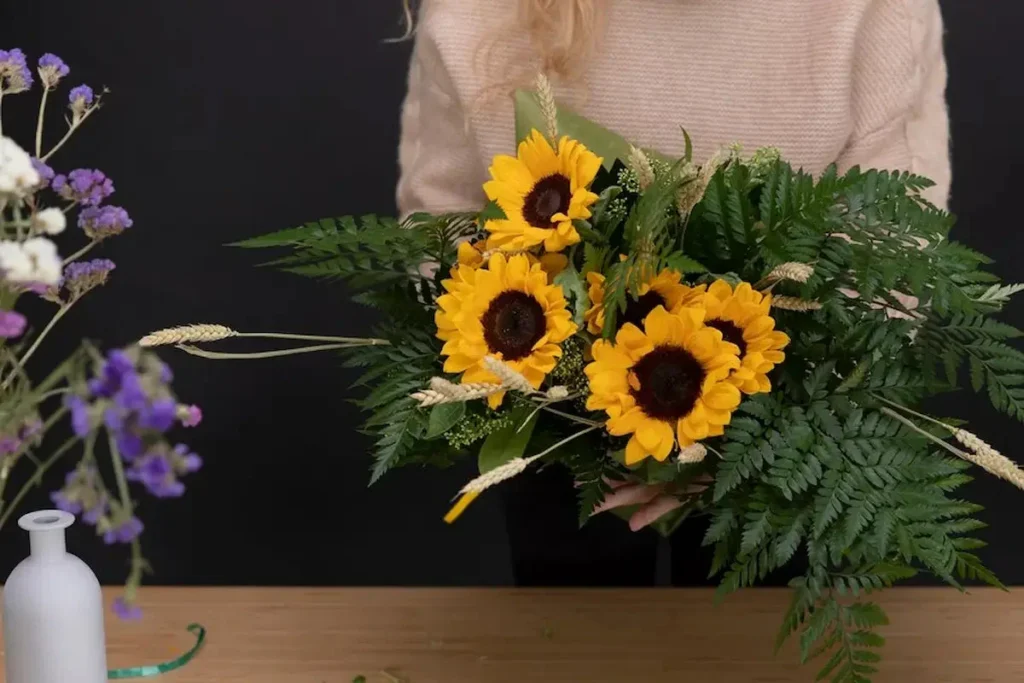
Yellow flowers are the most useful colour in the trade and the least requested. Customers ask for red, blush, white and “something purple.” Florists, buying for their own homes, buy yellow.
There are good reasons for that, and they are worth knowing, because yellow solves several problems that other colours cannot.
What Yellow Actually Signals
Colour carries meaning in flowers whether you intend it or not, and yellow occupies a genuinely useful position.
Red reads as romantic, and reads that way so strongly it has become almost unusable for anything else.
White reads as formal, sympathetic or ceremonial. Beautiful, but it carries weight.
Pink reads as affectionate, and slightly soft.
Yellow reads as warmth without romance. Friendship, gratitude, celebration, encouragement, cheerfulness. It is the only colour you can send to a colleague, a neighbour, a friend recovering from surgery, your accountant or your mother without any risk of the gesture being misread.
That makes yellow flowers the correct default for thank yous, get-wells, birthdays, new jobs, congratulations, and anything where the relationship is warm but not romantic.
The Practical Reasons Florists Love It
Beyond meaning, yellow has real technical advantages.
It carries visually. Yellow is the most luminous colour in the spectrum and reads from across a room. Deep blues and purples disappear against green foliage and in dim rooms. Yellow does not.
It works in leafy Sydney homes. Much of the North Shore has substantial green outside every window – established gardens, bushland reserves, mature street trees. A bouquet has to compete with all that existing green. Warm colours win that fight; cool colours lose it.
It photographs well. Under warm indoor lighting, yellow holds its colour. Purple goes black and pale pink goes grey.
It is usually good value. Yellow is not caught in the price spikes that hit red roses in February and white flowers around funeral demand.
It suits Australian light. Sydney’s light is bright and hard. Yellows, golds and warm tones hold up in it; delicate pastels wash out.
Every Yellow Flower Worth Knowing
Spring (Sep-Nov)
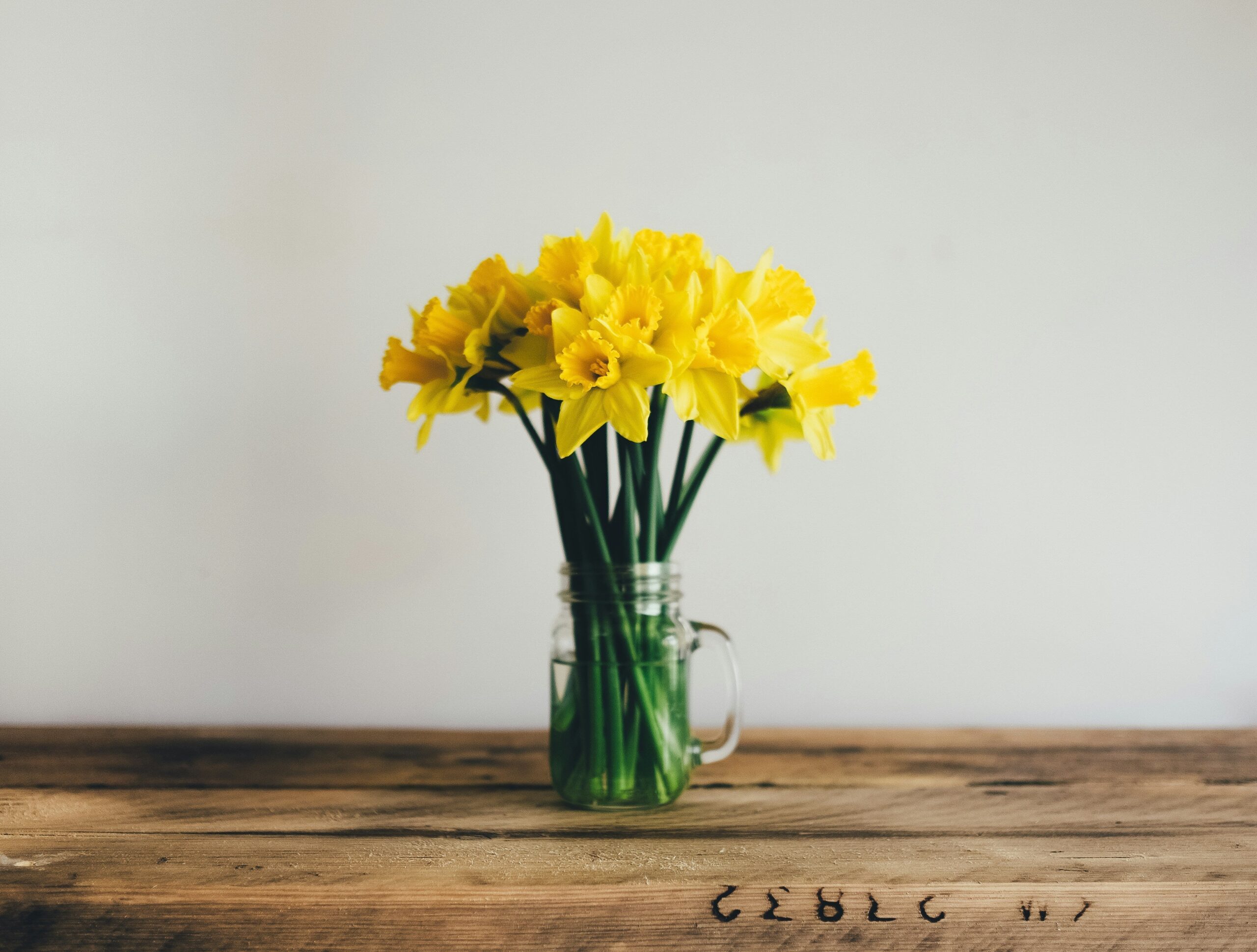
- Daffodil and jonquil – early spring, cheap, fragrant, unmistakably seasonal. Keep them in their own water for the first day; they exude sap that shortens other flowers’ lives.
- Yellow tulip – clean, structural, excellent value.
- Yellow ranunculus – tightly layered petals, one of the most beautiful things in the market.
- Freesia – powerfully fragrant, and the yellow varieties are the strongest scented.
- Yellow garden rose – warm butter through to apricot. Superb.
- Craspedia (billy buttons) – perfect little yellow spheres on bare stems. Long lasting, and they dry perfectly.
Summer (Dec-Feb)
- Sunflower – the obvious one, and genuinely great. Enormous presence, cheap, robust in heat.
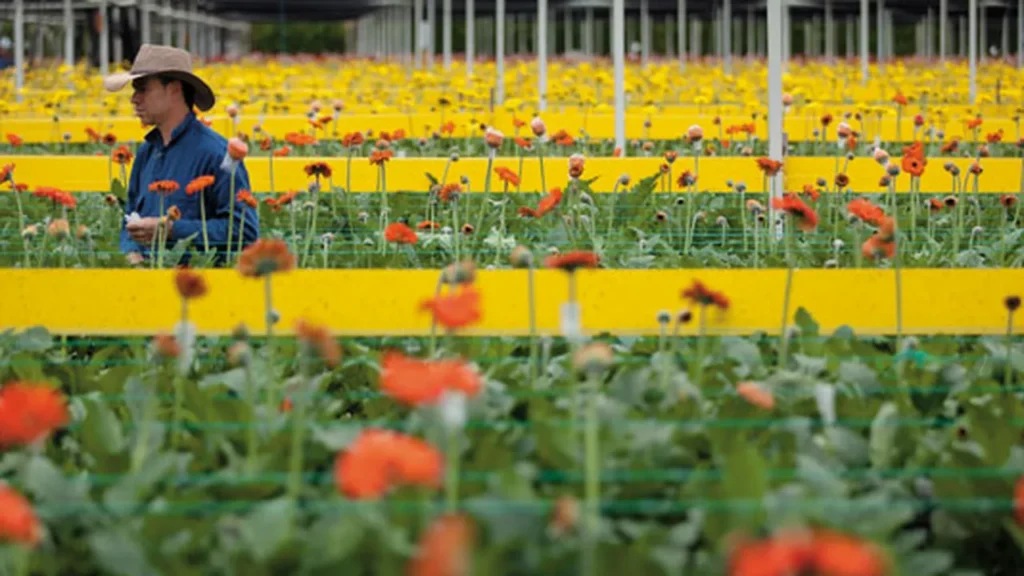
- Yellow gerbera – cheerful, clean, long-lasting if the stems are kept in shallow water.
- Yellow dahlia – generous, ruffled, spectacular in the larger varieties.
- Yellow lisianthus – delicate-looking, genuinely tough, opens progressively over a week.
- Golden rod (solidago) – a workhorse filler that deserves better than its reputation.
- Yellow orchid – expensive per stem, weeks of vase life.
Autumn (Mar-May)
- Yellow and bronze chrysanthemum – the modern varieties are outstanding and nothing like the servo bunch. Extraordinarily durable.
- Yellow dahlia continues into autumn.
- Celosia in the gold and orange tones – velvety, textural, unusual.
- Yellow leucadendron – native, structural, lasts weeks.
- Berried and rust-toned foliage to sit alongside.
Winter (Jun-Aug)
- Wattle (acacia) – Australia’s own, and one of the great winter flowers. Powerfully fragrant, unmistakably local, and gone in a flash. Worth catching.
- Yellow hellebore – subtle and beautiful.
- Kangaroo paw in the yellow and green varieties – architectural, native, extremely long-lasting.
- Yellow banksia – the classic native, essentially indestructible.
- Jonquil – the earliest of the spring bulbs, often appearing in late winter.
What Yellow Pairs With
- Yellow and white – clean, fresh, endlessly appropriate. The safest professional combination.
- Yellow and cream – softer, more elegant, less shouty.
- Yellow with rust and bronze – the best autumn combination available.
- Yellow with deep burgundy – unexpected and genuinely striking. High contrast, very current.
- Yellow with grey-green foliage – olive, eucalyptus, dusty miller. Understated and sophisticated.
- Yellow and coral or peach – warm, generous, holiday-ish in the best way.
Avoid: yellow with pale pink (muddy), and yellow with purple in equal measure (it reads as a sporting team).
And a general principle: two colours plus foliage beats five colours almost every time. Yellow is strong enough to lead on its own.
When Not to Send Yellow
Worth knowing the exceptions.
As a romantic gesture. Yellow specifically does not read romantically. If romance is the intent, yellow undersells it.
Some cultural contexts. In parts of Latin America and in some European traditions, yellow flowers carry associations with jealousy or farewell. In Iran, yellow can signal the end of a relationship. Worth a moment’s thought if the recipient’s background makes it relevant.
Some funerals. Yellow and white chrysanthemum are traditional and appropriate in Chinese and many Asian funeral customs. In other contexts bright yellow can feel too cheerful. White and cream is the safer sympathy choice unless you know the person loved yellow, in which case it is the better one.
Acid yellow in volume for older recipients. Bright acid yellow can read juvenile. Butter, cream and gold tones are more elegant.
Wattle: The One Worth Waiting For
A note on Australia’s floral emblem, because it deserves it.
Wattle is one of the great flowers and a very short-lived cut flower. It appears in late winter, is intensely fragrant, and drops within days. It is worth buying anyway – a jug of wattle in July is one of the genuine pleasures of the Sydney flower year.
It is also part of a substantial local industry. NSW has a significant native and wildflower growing sector alongside its traditional flower production, described in the state’s horticulture and primary industries resource s, with growers along the coastal strip and inland districts.
The science on why native yellows last so differently is well documented. Australian postharvest research on vase life determinants in cut acacia foliage found season of harvest to be the dominant factor in longevity, and that postharvest treatment extended vase life roughly 1.4-fold – which is exactly why wattle from a florist who conditions properly outlasts wattle cut from a roadside.
On that: do not pick wattle or other natives from bushland. Commercial harvest of protected native plants in NSW is licensed, and the cut-flower licensing framework sets out which species require grower or wild-harvester licences and tags. Buy from a florist who sources from licensed growers.
What to Order and What to Spend
Ask for “designer’s choice, yellow and cream, in season, this is my budget.”
That brief consistently outperforms picking a catalogue photo. Fixed products force a florist to buy named varieties whatever the market did that morning; a free brief lets them buy what was excellent and give you more of it.
- $60-90 – a genuine yellow posy or single-variety hand-tie. Sunflowers, tulips or craspedia.
- $100-150 – the standard yellow bouquet with a proper focal group.
- $160-250 – generous, with garden roses or specialty stems.
- $300+ – statement work, or a fortnightly standing order.
Delivery Notes for Sydney
- Include the recipient’s mobile number. The highest-value field on any order.
- Offices before 3pm. Yellow is the safest office colour by a wide margin.
- Hospitals: ring the ward first; some units do not accept fresh flowers.
- Sunflowers and gerbera prefer shallow water. Mention it or they will wonder.
Lower North Shore same-day cut-offs run around 1pm for the core ring (North Sydney, Cremorne, Neutral Bay,
Kurraba Point, Mosman, Cammeray, Crows Nest, Kirribilli, Milsons Point, Lavender Bay, McMahons Point,
Waverton, Wollstonecraft, Cremorne Point), 11am to midday for Chatswood, Willoughby, Northbridge, Lane
Cove, Artarmon, Naremburn, Greenwich, Riverview, Longueville, Linley Point, Roseville, Manly and Seaforth, and 10am to 11am for Hunters Hill, Woolwich, Huntleys Cove, Huntleys Point, Gladesville, West Pymble, Clontarf, Balgowlah Heights and Allambie Heights.
Care
- Recut stems 2cm at a 45-degree angle with sharp blades, immediately.
- Wash the vase in hot soapy water and scrub it.
- Strip every leaf below the waterline.
- Use the flower food sachet.
- Change the water completely every second day and recut.
- Keep daffodils and jonquils in their own water for the first 24 hours.
- Sunflowers and gerbera like shallow water – their stems rot in deep water.
- Away from the fruit bowl and out of the afternoon western sun.
The Bottom Line
Yellow flowers are the most useful colour available: they read as warmth without romance, they carry visually in leafy Sydney homes where cool colours vanish, they photograph well under warm light, and they usually cost less than red or white. Send them for thank yous, get-wells, birthdays and congratulations. Pair them with white, cream, rust or deep burgundy. And catch the wattle in July, because it is gone in a fortnight.